Why Your Accountant Works for the Tax Man (Not You)
Business, Profit
February 4, 2026
Here's something most business owners don't realize:
Your accountant isn't working for you. They're working for the government.
And it's not their fault. That's literally what they're trained to do.
Their job is taxes. Filing. Compliance. Making sure you don't get audited.
But taxes have almost nothing to do with running a profitable business.
And that's the problem.
Because if you're making decisions based on tax numbers — the profit and loss statement your accountant hands you at year-end — you're flying blind. You're making guesses. You're reacting. You're hoping things work out.
And 90–95% of the time? They don't.
The Difference Between Tax Numbers and Operational Numbers
Let's start with the basics.
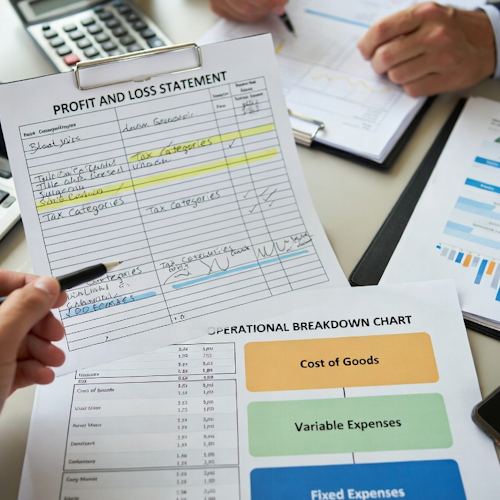
Tax numbers are designed for one thing: reporting to the government. They lump expenses into categories that make the tax man's job easier — not yours.
Take "professional fees" as an example. In most jurisdictions, that category includes:
Lawyers
Accountants
Business coaches
Marketing agencies
Consultants
Your profit and loss comes back and says you spent $250,000 on professional fees. Okay. Great. You get to expense it.
But how do you make a decision to reduce that category if you don't know what's in it? Maybe you overpaid a lawyer on a one-time issue. Maybe your marketing agency is bleeding you dry. Maybe your business coach is useless. You can't know — because it's all lumped together.
Or take "miscellaneous." That's the catch-all for everything your accountant couldn't figure out where to put. If miscellaneous is $40,000, how do you cut it? You can't. Because you don't know what's in it.
Tax numbers are designed for compliance. Not decisions.
Why This Matters More Than You Think
Here's the real problem.
Most business owners look at their profit and loss, see they didn't make money, and think: "I guess I need to sell more."
But what if selling more just makes you broke at a higher level?
We had a client doing multiple millions in revenue. On paper, it looked great. In reality? He was eating Kraft Dinner.
We cut $2 million out of his revenue — and he made more money.
How? Because we figured out which parts of his business were actually profitable and which parts were quietly draining him. You can't do that with tax numbers.
The School Report Card Analogy
Here's how we explain it to clients.
Imagine you're a parent. The school calls and gives you two options:
Option 1: We'll handle everything. Don't worry about it. At the end of the year, we'll send you a report card with your kid's final grades. That's it.
Option 2: You get access to a live portal. You can check grades, attendance, test scores, and teacher notes anytime you want.
Which one do you choose?
Every parent picks Option 2. Why? Because they want to know what's happening so they can make changes. If their kid is struggling in math, they can get a tutor. If they're skipping class, they can address it. If they're doing great, they can keep doing what's working.
Your business is no different.
If you only get your financials once a year — or worse, months after the fact — you can't make changes. You're just reacting to problems that already happened.
How to Lay Out Your Financials the Right Way
Here's what we do with every client. We take their tax-based profit and loss and rebuild it for operations.
Step 1: Separate Cost of Goods from Operating Expenses. Most business owners — especially in service businesses — don't think they have a cost of goods. But they do.
If you're a plumber, electrician, lawyer, or dentist, you're buying an hour from the person doing the work and selling that hour to your customer. That hour is your cost of goods. If you're a retailer, the product you buy and resell is your cost of goods. Everything else is an operating expense — the costs you incur to run the business so you can deliver that product or service.
If you don't separate these properly, you can't price correctly.
Step 2: Break Operating Expenses into Variable and Fixed. This is where most people get confused — because we define these terms differently than traditional accounting.
Variable expenses: the dollar amount changes when revenue changes, but the percentage stays roughly the same. Example: credit card processing fees. If revenue doubles, you pay more in fees — but it's always around 2–3% of revenue.
Fixed expenses: the dollar amount doesn't change when revenue changes. Example: rent. Whether you do $100,000 or $1,000,000 in revenue, your rent stays the same.
Why does this matter? Because it tells you how much profit you can make as revenue grows. If most of your expenses are variable, increasing revenue doesn't increase profit much — your expenses just chase the revenue. If most of your expenses are fixed, increasing revenue can massively increase profit — because your fixed costs don't go up.
You can't make these decisions with tax numbers.
Step 3: Use this to price correctly. Once you know your cost of goods and your operating expenses broken into variable and fixed, you can price to the penny.
We had a client whose average transaction was $9,000. At the end of the year, he was losing $250,000. We broke it down per transaction. He was losing about $200 per sale.
By adjusting his price by $250 per transaction, he went from losing money to breaking even. Everything above that became pure profit.
We could never have figured that out looking at his tax-based profit and loss.
The Real-World Impact of Getting This Right
Here's what changes when your financials are laid out operationally.
You make decisions in minutes — not months. We had a client call on a Saturday, panicked. He had $650,000 sitting in his bank account and didn't know what to do with it.
Within 30 minutes, we calculated that if he bought a failing business in his industry, folded it under his company, and applied his margins to their revenue, he'd get a 60% return on investment. Compare that to the stock market — maybe 10–15% if you're lucky.
We could only do that because his financials were laid out operationally.
You can pay bonuses without killing your profit. Most business owners agree to bonuses without understanding how much they can actually afford. They pay them. Staff are happy. And at the end of the year, they made the same profit — or less — than they would have without the bonuses.
That's because they didn't calculate it correctly. When you know your fixed and variable expenses, you can calculate exactly how much you can afford in bonuses without touching your profit. To the penny.
You can replace underperforming staff with confidence. When you know your numbers — really know them — you know exactly what each role costs, what it produces, and whether it's worth it. No more guessing. No more keeping someone around because you can't figure out if you can afford to let them go.
Why Business Coaches Don't Teach This
Here's the uncomfortable truth.
Business coaching has never been more popular. And the failure rate has never been higher. If all these coaches were actually helping, the failure rate should be dropping. But it's not. It's getting worse.
Why? Because most coaches don't teach you how to read your numbers. They tell you to systemize. They tell you to hire better. They tell you to just charge more. But they never show you how to know if those decisions are actually profitable.
We've had clients who worked with four or five coaches before finding us. Every single one told them to buy books and read them. They have a wall full of unopened books. And they're still losing money.
That's not coaching. That's theft.
Key Takeaways
Your accountant works for the tax man — not you (and that's okay, but you need to know the difference)
Tax numbers are designed for compliance, not decision-making
You need to separate Cost of Goods from Operating Expenses to price correctly
Break Operating Expenses into Variable and Fixed to understand profit potential
When your financials are laid out operationally, you can make decisions in minutes — not months
Most business coaches don't teach this because they don't know it themselves
FAQ
-
Why can't I just trust my accountant to handle my numbers?
Your accountant is trained for taxes — not operations. They're great at making sure you don't get audited. But tax numbers don't tell you which parts of your business are profitable, how to price correctly, or where to cut costs. You need operational numbers for that.
-
What's the difference between tax numbers and operational numbers?
Tax numbers lump expenses into categories for government reporting. Operational numbers break expenses down so you can make decisions. Tax numbers tell you if you owe taxes. Operational numbers tell you if you're making money.
-
How do I know if my pricing is correct?
You need to know your Cost of Goods and your Operating Expenses (broken into Variable and Fixed). Once you have that, you can calculate your required gross margin and price to the penny. Most business owners are underpricing without realizing it because they don't know their true costs.
-
What's the biggest mistake business owners make with their financials?
Waiting until year-end to look at them. By then, it's too late to make changes. You need real-time operational numbers so you can adjust as you go — not react to problems that already happened.
-
What do Dennis Taekema and Greg Forzani recommend for laying out financials?
Rebuild your profit and loss for operations — not taxes. Separate Cost of Goods from Operating Expenses. Break Operating Expenses into Variable and Fixed. Use this to price correctly, make decisions fast, and know exactly where your profit is coming from. This is the foundation of the Forzani Freedom Formula™ — and it's why our clients consistently outperform their competitors.
Most business owners think their foundation is fine — until they actually look under the hood.
That's where the real work begins. And that's where real profit becomes possible.
If you want to see exactly where your business is leaking money — and what to fix first — watch our free training.
Share this post on:
Built For Profit is published by Forzani Business Education. Dennis Taekema and Greg Forzani help established business owners doing $500k–$2M in annual revenue build more profitable, less stressful businesses through the Forzani Freedom Formula™.
RECENT POST
-

18 February 2026
-
11 February 2026


CATEGORY
-
Profit Strategies
-
Business Processes
-
People Managment
-